
Best Emirates for Discounted Property in 2026
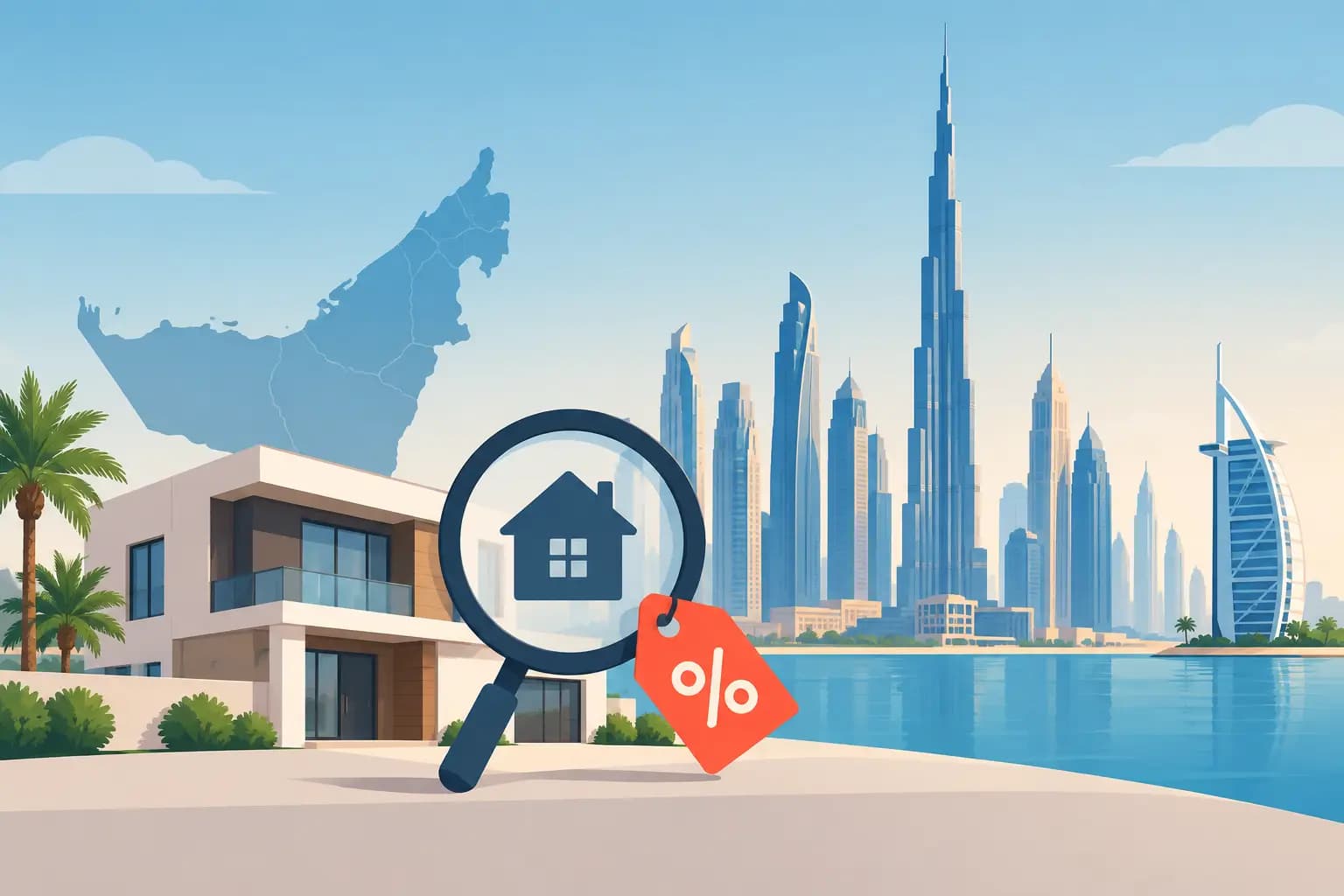
A 15% discount is only a real opportunity if the asset can be financed, rented, or resold at a credible market price. That is why the best emirates for discounted property are not automatically the markets with the lowest asking prices. For investors, the winning location combines a visible price gap with enough demand to turn that gap into equity.
Across the UAE, distressed resales, urgent sales, off-plan exits, developer inventory, and bank-led opportunities can create serious entry points. But each emirate has a different liquidity profile, tenant base, supply pipeline, and buyer pool. A discounted unit in Dubai may move quickly at 8% below market. A unit in a secondary area of another emirate may need a much deeper discount before it becomes a viable fast flip.
The right move is to match the emirate to your investment strategy, then verify the comparable sales before you make an offer.
Best Emirates for Discounted Property by Investment Goal
Dubai remains the strongest market for investors who prioritize liquidity, price transparency, and multiple exit routes. Abu Dhabi is a compelling play for income-focused buyers who want stability and premium end-user demand. Ras Al Khaimah has become a higher-upside tourism and lifestyle market, while Sharjah and Ajman can produce lower-ticket, cash-flow-oriented opportunities.
There is no single best choice for every buyer. The better question is: where does your required discount meet genuine buyer or tenant demand?
Dubai: Best for Liquidity, Flips, and Off-Plan Exits
Dubai is the UAE's most competitive discount market because it has the deepest pool of buyers, agents, lenders, tenants, and active developers. That competition can reduce the number of obvious bargain listings, but it also makes market pricing easier to validate. If a motivated seller needs speed, a 5-15% discount against recent comparable transactions can be meaningful, especially in established communities with steady resale activity.
Dubai works particularly well for investors targeting urgent resale deals, investor exits before handover, and properties where a seller's timeline matters more than achieving the last dollar of value. Areas with high transaction volume generally offer cleaner comparables and a faster route to resale. That matters when your strategy depends on a fast flip rather than a long hold.
The trade-off is clear: Dubai discounts are often narrower in prime or high-demand neighborhoods. A listing advertised as below market is not automatically a deal. Check the unit's view, floor, layout, service charges, payment status, occupancy, and handover date. A lower price may reflect a real defect, not a distress discount.
For experienced investors, Dubai can also offer attractive off-plan exits. Sellers who need to release capital may assign a contract below current market positioning. The best opportunities usually have a clear handover path, a strong developer, manageable remaining installments, and comparable projects trading at higher levels. A headline discount means little if the next payment is due before you have the cash to complete.
Abu Dhabi: Best for Defensive Income and Quality Demand
Abu Dhabi is less speculative than Dubai in many segments, which can make it attractive for buyers focused on rental income, capital preservation, and longer holding periods. Discounted inventory may appear through urgent resales, owner exits, and units priced below competing listings in established apartment and villa communities.
The market often rewards patience. Instead of chasing a rapid price spike, an investor can focus on acquiring a quality unit with a defensible tenant profile at a favorable basis. Strong employment anchors, family demand, and premium master-planned communities can support this approach.
The key risk is assuming that a discount guarantees easy resale. Some submarkets have thinner transaction velocity than Dubai, and individual building quality can make a major difference. Compare not only asking prices but closed deals, active competing stock, annual service charges, and actual achievable rents. A 10% discount on a high-expense unit can disappear quickly if net yield is weak.
Abu Dhabi is a strong fit when the deal has two supports: an entry price below verified market value and a rental case that still works after all ownership costs.
Ras Al Khaimah: Best for Tourism-Led Upside
Ras Al Khaimah has moved onto the radar of investors looking for lifestyle-driven appreciation, hospitality demand, and lower entry prices than top Dubai coastal locations. The market can create compelling value where a seller is exiting early, where a resale needs fast closure, or where a developer has limited remaining stock at a higher price point.
This is not a market to buy purely from a brochure. Tourism-led growth can create upside, but it also makes project selection critical. A discounted property in the right waterfront, resort-adjacent, or established lifestyle community can have strong appeal. A discounted unit in a location with weak year-round demand may remain discounted for much longer than expected.
Investors should pressure-test both rental strategies. Long-term leasing may offer consistency, while short-term or holiday rental potential may offer higher gross income but requires management, seasonality planning, and realistic occupancy assumptions. Do not underwrite a deal using peak-season nightly rates alone.
Ras Al Khaimah is best for buyers willing to hold through a growth cycle and selectively pursue high-equity positions. It is less suitable for investors who need immediate, high-volume resale liquidity.
Sharjah: Best for Value Buyers and Steady Rental Demand
Sharjah can deliver a lower cost basis than Dubai while benefiting from commuter demand and a large resident population. For investors, the opportunity is often less about a dramatic speculative flip and more about buying a well-located unit at a discount, improving the income profile, and holding for yield.
Urgent sales can appear when owners need liquidity, particularly in mature apartment stock. The strongest deals tend to be those close to established employment, transport corridors, retail, schools, and daily amenities. At the right entry price, a modest apartment can deliver a practical rental proposition.
The trade-off is that Sharjah requires careful due diligence on building condition, ownership structure, financing availability, and buyer eligibility. Resale depth can vary sharply between communities. A cheap unit with high maintenance exposure or limited buyer demand is not an investor win.
Look for a discount that compensates for reduced liquidity. In a slower-moving building, you should demand a deeper spread than you would in a highly traded Dubai community.
Ajman: Best for Low-Entry Cash Flow Plays
Ajman appeals to investors seeking accessible entry prices and potential rental yield. The emirate can be especially relevant for cash buyers and portfolio builders who want to acquire multiple lower-ticket units rather than concentrate capital in one premium asset.
Discounted property here is often tied to motivated owners, older inventory, and resale units where speed matters. The right purchase can produce a strong yield on paper, but gross yield is not the number that counts. Calculate service fees, vacancy allowance, maintenance, leasing costs, and any renovation needed to make the unit competitive.
Ajman is usually a hold-market decision, not a fast-flip decision. Liquidity can be more limited, and relying on quick appreciation is risky. The best Ajman opportunities are priced far enough below local comparables that the income covers the wait.
How to Compare a Discount Across Emirates
A discount should be measured against a real benchmark, not against a seller's original purchase price or an inflated listing price. Start with recent comparable sales for the same building or community, then adjust for unit size, view, floor, condition, parking, occupancy, and payment obligations.
Next, assess the exit. In Dubai, the exit may be resale to another investor or an end user. In Abu Dhabi, it may be a stabilized rental hold. In Ras Al Khaimah, the exit may depend on a broader tourism thesis. In Sharjah and Ajman, the income return may be the main reason to own the asset.
A useful deal screen includes four numbers: verified market value, all-in acquisition cost, realistic annual net income, and the estimated time required to sell. If the property is 12% below market but needs 8% in repairs and has six months of carrying costs, the discount is thinner than it first appears.
Also verify the reason for sale. An urgent seller can create a genuine price advantage. A seller avoiding unresolved service charges, delayed handover exposure, or a difficult tenancy situation can create a problem disguised as a bargain. Demand documents early and make the deal's downside visible before you negotiate the upside.
Where Smart Investors Start
For fast-moving investors, Dubai is usually the first stop because liquidity gives a discount more practical value. For defensive yield, Abu Dhabi deserves serious attention. For growth-led, selective buying, Ras Al Khaimah can offer asymmetric upside. Sharjah and Ajman are better suited to buyers who prioritize lower acquisition costs and patient income generation.
The strongest discounted property is not the one with the biggest red percentage label. It is the one where the discount survives due diligence, the exit is credible, and the seller's urgency gives you room to act before the market catches up. When a verified deal shows that combination, move quickly, validate the numbers, and negotiate from the strength of your data.